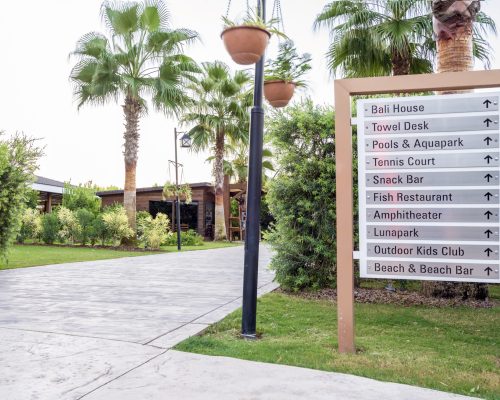
6 Key Steps to Successful Exterior Wayfinding for Your Resort
September 14, 2026
Wayfinding plays a critical role in how guests experience large resort environments. These properties often include multiple buildings, amenities, and pathways, making navigation a key part of the overall experience.
For organizations managing complex properties, wayfinding is not just directional signage. It is a coordinated system designed to guide movement, reduce confusion, and support a consistent brand experience across the entire environment.
1. Establish Clear Navigation Hierarchy

Great wayfinding starts with a clear and intuitive navigation system. Guests should be able to understand where they are, where they need to go, and how to get there without hesitation.
A strong system includes:
- Entry signage that establishes orientation
- Directional signage at key decision points
- Identification signage confirming arrival
Wayfinding systems are most effective when they are designed around how people move through a space, not just where signs are placed. Clear hierarchy reduces confusion and improves overall navigation.
At Hyatt Regency Lost Pines Resort and Spa, this meant mapping the entire guest journey before designing a single sign. The team walked the property, documented every existing sign, and identified where guests naturally paused or made decisions. From there, signage was structured to guide movement from arrival through key destinations, using consistent placement and messaging to reinforce the path forward.
In large properties, this hierarchy must remain consistent across all areas to maintain usability.
2. Design for Scale and Environment

Resort environments introduce unique challenges that differ from interior or single-building signage. Outdoor exposure, distance, and varying lighting conditions all affect how signage performs.
Wayfinding in these environments must account for:
- Long viewing distances
- Changing light conditions throughout the day
- Weather exposure and material durability
- Multiple access points and entry paths
In resort settings, signage must function across large, open areas and multiple structures, requiring a system that responds to both scale and environmental conditions.
At Hyatt Regency Lost Pines Resort and Spa, some of the exterior wayfinding signs stood over 5 feet tall, but within the scale of the property, they felt surprisingly understated. Surrounded by expansive pathways, mature trees, and large resort buildings, the signs were designed to provide visibility at a distance without distracting from the environment. Their scale worked with the property, not against it.
3. Maintain Brand Consistency Across the Property

Wayfinding is not separate from branding. It is part of the overall visual experience.
Consistent use of:
- Color
- Typography
- Materials
- Design language
helps create a cohesive environment and reinforces brand identity. In hospitality environments, consistency contributes to a more immersive and premium experience for guests.
When signage varies between locations or areas, it can disrupt the experience and reduce clarity.
4. Prioritize Placement at Decision Points

The right sign in the wrong location is still the wrong sign. To be effective, signage must appear where people naturally look for information and where decisions need to be made.
Wayfinding signage should be placed:
- At entrances
- At intersections and transitions
- At moments where users must choose a direction
Effective placement aligns with real movement patterns and ensures signage supports decision-making in real time.
At Park Hyatt Aviara, this was especially important because of the sheer scale of the property. Guests frequently traveled between amenities by golf cart, making clear vehicular directionals a critical part of the overall experience. Many of the existing signs had become weathered and difficult to read over time, while updates to resort attractions created a need for refreshed messaging. Egan was brought in to revitalize the existing directional signage, improving readability and clarity so guests could navigate the property more confidently and comfortably.
5. Integrate Materials and Durability
The best exterior wayfinding signage is designed to stand the test of time. Material selection should reflect both environmental conditions and the overall design of the property.
Durable materials that complement the surrounding architecture help signage remain legible and consistent despite weather exposure and long-term use. In resort environments, materials are often selected to align with the surrounding architecture and landscape.
These decisions are typically part of a broader system that includes fabrication, installation, and long-term upkeep.
6. Coordinate Wayfinding as a System
Wayfinding should not be treated as a collection of individual signs. It functions as a connected system that guides users from arrival to destination.
This includes:
- Entry signage
- Directional signage
- Identification signage
- Environmental cues and landmarks
When designed as a system, wayfinding reduces friction, improves flow, and enhances the overall experience.
At Hyatt Regency Lost Pines Resort and Spa, the wayfinding program was intentionally designed to feel cohesive across the entire property. Materials, colors, fonts, and icons were standardized throughout the system so guests experienced consistent visual cues from the entry gate to the bike rentals and beyond. That consistency helped reinforce navigation while also making the signage feel naturally integrated into the resort environment.
In large-scale environments, coordination across all elements is necessary to maintain consistency and usability.
Wayfinding System Considerations
Exterior wayfinding in resort environments is most effective when it is treated as a connected system rather than a series of individual signs. Clear hierarchy, consistent design, and strategic placement all contribute to how easily guests move through a property.
In large-scale resort settings, these systems are typically planned and coordinated across multiple areas to ensure consistency, usability, and long-term performance.